
If your doctor has advised you to get an angiography done, the first thing you probably did was search for what it actually means. What happens during the procedure? Is it painful? How long does it take? What should you do before and after?
These are completely valid questions, and you deserve clear, honest answers. In this blog, Dr Gaurav Yadav, a DrNB interventional cardiologist at Hridayam Cardiac & Diagnostic Centre, Haldwani, with over 8,000 angiographies performed, explains everything you need to know about angiography in simple, easy-to-understand language.
So, what is angiography, exactly? Let us break it down clearly.
What is angiography? At its core, it is one of the most important and accurate diagnostic tools in modern cardiology. Understanding it fully will help you feel more confident and prepared before your procedure.
What is angiography? – Definition and Purpose
Angiography is a specialised medical imaging procedure used to visualise the inside of blood vessels, particularly the arteries supplying blood to the heart. The word comes from the Greek words “angeion“ (vessel) and “graphia“ (writing or recording), literally meaning “recording of blood vessels”. “In simpler terms, what is angiography if not the heart’s most precise diagnostic map?”
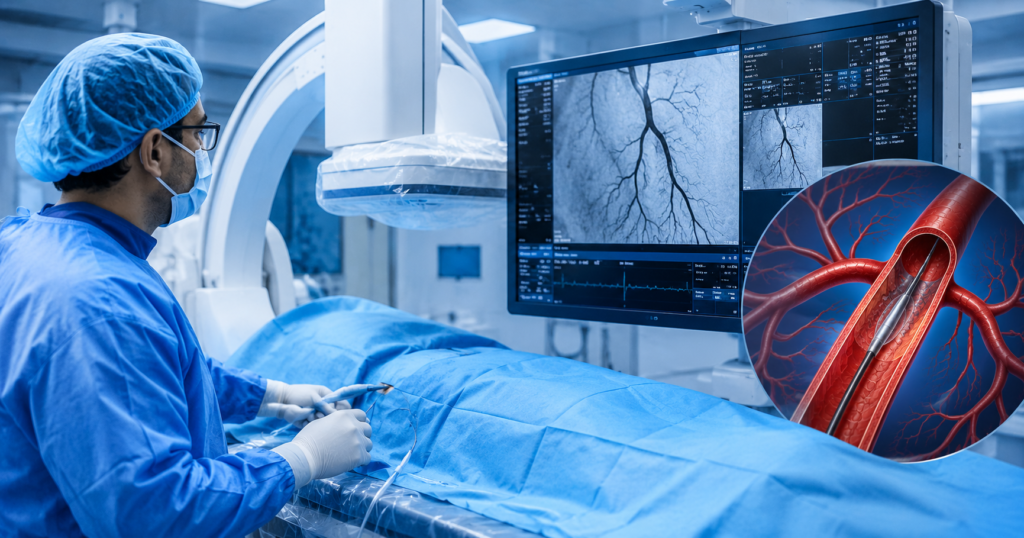
During an angiography, a special contrast dye is injected into the blood vessels through a thin, flexible tube called a catheter. This dye makes the blood vessels visible on X-ray images, allowing the doctor to clearly see any blockages, narrowings, or abnormalities that might be restricting blood flow to the heart.
According to the American Heart Association, coronary artery disease is one of the most common and serious heart conditions worldwide, and coronary angiography remains the gold standard for its diagnosis.
Coronary angiography, the most common type, is specifically used to examine the coronary arteries, which are the blood vessels that supply oxygen-rich blood to the heart muscle itself. When these arteries become narrowed or blocked, it can lead to chest pain, heart attack, or other serious cardiac conditions. Angiography is the most accurate way to identify exactly where a blockage is, how severe it is, and what treatment is needed.
In simpler terms, what is angiography if not the heart’s most precise diagnostic map?
It is important to understand that angiography is primarily a diagnostic procedure; its job is to find the problem and give the doctor a precise map of what is happening inside your coronary arteries. Based on the findings, Dr Gaurav Yadav then decides the most appropriate treatment, whether that is medication, lifestyle changes, or an interventional procedure like angioplasty.
Why is angiography done? When Does a Doctor Recommend It?
Coronary angiography is recommended when a doctor suspects that the coronary arteries may be blocked or narrowed. The most common reasons a patient is advised to get angiography done include:
1. Chest pain or angina that does not respond well to medication or keeps recurring
2. Abnormal results on an ECG, stress test, or echocardiogram that suggest reduced blood flow to the heart
3. A heart attack, to identify which artery is blocked and decide on emergency treatment
4. Shortness of breath that is unexplained and may be related to reduced heart function
5. Before a major surgery, to assess whether the heart is strong enough to handle the procedure
6. To plan or evaluate treatment, such as before or after a coronary angioplasty or bypass surgery
Angiography is not done routinely; it is specifically recommended when other investigations suggest a problem that needs to be examined more closely. If Dr Gaurav Yadav has advised you to get this done, it means he needs precise information about your coronary arteries to give you the safest and most effective treatment.
How is angiography done? The Step-by-Step Procedure
Understanding how angiography is done step by step can make the experience far less intimidating. Here is exactly what happens at Hridayam Cardiac & Diagnostic Centre:
Step 1 – Preparation Before the Procedure
Before the angiography begins, the medical team carries out a series of preparatory steps to ensure the procedure is safe and effective. Blood tests, a chest X-ray, and an ECG are usually done beforehand. You will be asked not to eat or drink anything for at least 4–6 hours before the procedure. Any medications you are taking, especially blood thinners, will be reviewed by Dr Gaurav Yadav, who will advise whether to continue or pause them. An intravenous (IV) line will be placed in your arm to administer fluids and medications during the procedure.
Step 2 – Entering the Catheterisation Laboratory
The angiography procedure takes place in a specialised room called a “catheterisation laboratory”, or “Cath Lab”. At Hridayam Cardiac & Diagnostic Centre, the Cath Lab is equipped with state-of-the-art imaging technology that allows Dr Gaurav Yadav to capture high-quality, real-time images of your coronary arteries with exceptional precision. You will lie on a padded table under a large X-ray camera. The room may feel cool, and there will be a small team of cardiac nurses and technicians present throughout.
Step 3 – Local Anaesthesia and Catheter Insertion
You will be given a local anaesthetic injection at the insertion site, usually the wrist (radial artery) or, less commonly, the groin (femoral artery). This numbs the area so you feel minimal discomfort. You remain awake and conscious throughout the procedure; you are not put under general anaesthesia. A small sheath (a hollow tube) is then inserted into the artery, and a thin, flexible catheter is guided carefully through the blood vessel all the way to the opening of the coronary arteries near the heart. This is done using real-time X-ray imaging to ensure precise placement.
Step 4 – Injecting the Contrast Dye
Once the catheter is correctly positioned, a small amount of contrast dye, a special iodine-based liquid, is injected through the catheter. As this dye flows through your coronary arteries, it makes them clearly visible on the X-ray screen. You may feel a brief sensation of warmth or flushing when the dye is injected; this is completely normal and passes within a few seconds. Dr Gaurav Yadav carefully studies the X-ray images as the dye flows through, looking for any areas of narrowing, blockage, or abnormality in the coronary arteries.
Step 5 – Completion and Recovery
Once all the necessary images have been captured, typically within 20 to 40 minutes, the catheter is carefully removed, and pressure is applied to the insertion site to stop any bleeding. You will be moved to a recovery area where the nursing team monitors your blood pressure, heart rate, and the insertion site for 2 to 4 hours. Most patients are discharged on the same day or the following morning. Dr Gaurav Yadav personally reviews the angiography images and discusses the findings with you and your family, explaining exactly what was found and what the next steps are.
Is Angiography Painful? What to Realistically Expect
Patients often ask what angiography is like in terms of pain and comfort — and the honest answer is that it is generally very well-tolerated.
The local anaesthetic injection at the insertion site causes a brief stinging sensation, similar to a standard injection. Once the anaesthetic takes effect, you should not feel the catheter being inserted or guided through the blood vessel. When the contrast dye is injected, you may experience a warm or flushing sensation for a few seconds; this is normal and harmless.
Some patients feel mild anxiety during the procedure, which is completely understandable. The team at Hridayam Cardiac & Diagnostic Centre is trained to keep you calm, informed, and comfortable throughout. If you feel anxious, you can speak to the team at any point.
After the procedure, the insertion site may feel sore or bruised for a day or two; this is normal and resolves on its own. Serious pain during or after the procedure is rare and should be reported to the medical team immediately.
Angiography Preparation. What Should You Do Before the Procedure?
Proper angiography preparation helps ensure the procedure goes smoothly and reduces the risk of complications. Here is what Dr Gaurav Yadav advises his patients at Hridayam:
1. Fast for 4–6 hours before the procedure, no food or water
2. Inform your doctor of all medications you are taking, especially blood thinners like aspirin, warfarin, or clopidogrel
3. Tell your doctor about any allergies, particularly to iodine or contrast dye, as this affects which dye is used
4. Arrange for someone to accompany you; you will not be able to drive yourself home after the procedure
5. Wear comfortable, loose-fitting clothing on the day
6. Remove jewellery and metal objects before the procedure, as these interfere with X-ray imaging
7. Stay calm and rest well the night before; a good night’s sleep makes a real difference to how you feel on the day
Following these preparation steps carefully makes a significant difference to your experience and the quality of the images obtained during the procedure.
Angiography Recovery Time. What to Do After the Procedure
Angiography recovery is generally straightforward and uncomplicated for most patients. Here is what to expect and what Dr Gaurav Yadav recommends during the recovery period:
On the day of the procedure:
You will rest in the recovery area for 2–4 hours after the procedure. The nursing team will monitor your vitals and check the insertion site regularly. Drink plenty of fluids to help flush the contrast dye out of your body through urine. You will not be allowed to drive; make sure someone is available to take you home.
In the first 24–48 hours:
Avoid heavy lifting, strenuous exercise, or any activity that puts pressure on the insertion site. The puncture site may be slightly sore or bruised; this is normal and will resolve on its own within a few days. Keep the site clean and dry, and follow the dressing instructions given by the nursing team.
When to call your doctor immediately:
1. Bleeding or swelling at the insertion site that does not stop
2. Chest pain or shortness of breath after the procedure
3. Fever or signs of infection at the site
4. Numbness or discoloration in the arm or leg where the catheter was inserted
Most patients return to their normal daily routine within 1 to 2 days after the procedure. Dr Gaurav Yadav schedules a follow-up appointment, usually within a week, to discuss the angiography findings in detail and plan the next steps in your treatment.
The National Health Service (NHS) recommends that patients follow their doctor’s post-procedure instructions carefully to ensure safe and smooth recovery after cardiac catheterisation procedures.
Angiography vs. Angioplasty. What is the difference?
Many patients confuse angiography and angioplasty; these are two different procedures, though one often follows the other.
| Angiography | Angioplasty | |
| Purpose | Diagnostic – finds blockages | Treatment – open blockages |
| What happens | Contrast dye is injected to visualise arteries | A balloon is inflated to open the blocked artery |
| Outcome | A detailed map of coronary arteries | Restored blood flow through the blocked artery |
| When done | Before deciding on treatment | After angiography confirms a significant blockage |
| Duration | 20-40 minutes | 30-90 minutes |
In simple terms, angiography is the investigation, and angioplasty is the treatment. Angiography first identifies the problem precisely, and if a significant blockage is found, Dr Gaurav Yadav may recommend proceeding with coronary angioplasty, either immediately or as a planned procedure.
Learn more about Coronary Angioplasty at Hridayam → https://hridayamclinic.com/coronary-angioplasty/
Risks of Angiography. What You Should Know
Angiography is a well-established, safe procedure, and at Hridayam Cardiac & Diagnostic Centre, it is performed with the highest safety standards under the direct supervision of Dr Gaurav Yadav. However, like any medical procedure, it carries a small risk of complications. Being aware of these helps you make an informed decision.
According to the World Health Organization, cardiovascular diseases are the leading cause of death globally, making accurate and timely diagnosis through procedures like angiography more important than ever. Early detection saves lives.
Rare but possible risks include:
1. Bleeding or bruising at the catheter insertion site, the most common minor complication, usually resolving on its own
2. Allergic reaction to the contrast dye is rare and managed promptly by the medical team if it occurs
3. Temporary abnormal heart rhythm during the procedure, usually self-resolving
4. Minor infection at the insertion site, extremely rare with proper sterile technique
5. Damage to the blood vessel at the insertion site, very rare and managed immediately if it occurs
Serious complications from angiography are extremely rare, especially when performed by an experienced interventional cardiologist. With over 8,000+ angiographies performed, Dr Gaurav Yadav has the expertise and experience to manage any situation safely and efficiently.
The benefits of getting an accurate diagnosis through angiography far outweigh the minimal risks involved, and delaying a necessary angiography can be far more dangerous than the procedure itself.
Angiography in Haldwani. Why Choose Hridayam?
For patients across the Kumaun region, including Nainital, Almora, Pithoragarh, Rudrapur, Bilaspur, Rampur, Kashipur, Bhimtal, and Mukteshwar, angiography in Haldwani at Hridayam Cardiac & Diagnostic Centre means you no longer need to travel to Delhi or Dehradun for this essential cardiac investigation.
Why patients across Kumaun choose Hridayam for angiography:
1. Dr Gaurav Yadav, DrNB Interventional Cardiologist trained at Sir Ganga Ram Hospital, New Delhi
2. 8,000+ angiographies performed with a 99% success rate
3. State-of-the-art Cath Lab with advanced real-time imaging technology
4. Transparent, personalised care: Dr Yadav personally explains all findings to the patient and family
5. Same-day discharge for most patients
6. Affordable pricing: contact us directly for accurate pricing information
Angiography in Haldwani — Full Details → https://hridayamclinic.com/angiography-in-haldwani/
Book Your Angiography Appointment at Hridayam Today
If you have been advised to get an angiography, or if you are experiencing chest pain, shortness of breath, or an abnormal ECG result, do not delay. Early and accurate diagnosis through angiography near me at Hridayam Cardiac & Diagnostic Centre can prevent serious complications and potentially save your life.
Dr Gaurav Yadav and his team are here to guide you through every step, from preparation to procedure to recovery, with complete transparency, expertise, and care.
Book Your Appointment Today → https://hridayamclinic.com/contact-us/
📞 +91 9068740555 | 📧 hridayamheartcarecentre@hridayam
📍Hridayam Cardiac & Diagnostic Centre, near Jungle Fiesta Complex, Haldwani, Uttarakhand – 263139
Frequently Asked Questions About Angiography
1. Is angiography the same as an angiogram?
Yes, “angiography” and “angiogram” refer to the same procedure. Angiography is the name of the technique, while “angiogram” refers to the X-ray image produced during the procedure. Both terms are used interchangeably by doctors and patients.
2. How long does angiography take?
A coronary angiography procedure typically takes between 20 and 40 minutes from start to finish. However, you should plan to spend approximately 4 to 6 hours at the hospital in total accounting for preparation, the procedure itself, and the post-procedure monitoring period before discharge.
3. Can I eat before angiography?
No, you must fast for at least 4 to 6 hours before the procedure. This means no food and no water during this period. Fasting is required to reduce the risk of complications during the procedure. Your doctor will give you specific instructions on when to stop eating and drinking based on your scheduled procedure time.
4. Will I be awake during angiography?
Yes, you will be fully awake and conscious throughout the angiography procedure. You are given a local anaesthetic at the insertion site, not general anaesthesia. Most patients tolerate this very well. If you feel anxious, the medical team can provide mild sedation to help you relax; speak to Dr Gaurav Yadav about this before the procedure.
5. How soon will I know the results?
Dr Gaurav Yadav reviews the angiography images immediately after the procedure and will discuss the findings with you and your family on the same day. You will know your results before you leave the hospital, along with a clear explanation of what was found and what the recommended next steps are.
6. What is the cost of angiography in India?
The cost of angiography varies depending on the hospital, city, and complexity of the case. For accurate and transparent pricing at Hridayam Cardiac & Diagnostic Centre, Haldwani, please contact us directly, and our team will provide you with all the information you need.
7. Where can I get angiography done in Haldwani?
Hridayam Cardiac & Diagnostic Centre in Haldwani is the most trusted and experienced cardiac centre for angiography in the Kumaun region. With Dr Gaurav Yadav performing over 8,000+ angiographies and a fully equipped cath lab, you are in the safest possible hands. To book your appointment, call +91 9068740555 or visit us near Jungle Fiesta Complex, Haldwani.
Disclaimer: This blog is written for general informational and educational purposes only. It does not constitute medical advice. Please consult Dr Gaurav Yadav or a qualified cardiologist for personalised medical guidance based on your individual condition.
